
Bag It & Bin It Please!
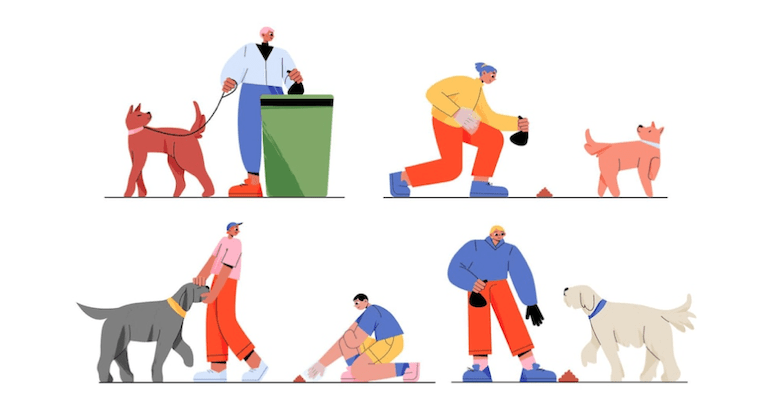
As a parish we have many lovely dog’s and we are a welcoming community to our 4 legged friends.
But owning a dog comes certain responsibilities, particularly when it comes to dealing with their toileting.
We have been informed that on numerous occasions a woofie has done their doings on the path between the parish hall and the church. This has been reported to the Dog Warden, but without witnessing the deed, they can only log the incident.
We ask our fellow Parishioners to keep their eyes peeled for dog owners that fail to collect their dogs waste, and report the owners to South Gloucestershire Council via this link
https://www.southglos.gov.uk/environment-and-planning/street-care-and-cleaning/dog-fouling-and-bins/
Health risks – dog fouling dangers and solutions
There is an estimate of more than 8 million dogs in the UK, producing around 1,000 tonnes of excrement per day. (Source: Keep Britain Tidy).
Dog fouling is a major concern to many people, not just because of the mess it causes, but because it can be a health risk. Dogs may deposit roundworm eggs (toxocara canis) in their faeces, which become infectious after about 3 weeks, and can remain so for up to 2 years.
Anyone, but particularly children playing near to the ground, can run the risk of picking up and swallowing the eggs. The eggs then hatch in the intestine, burrow through the intestine wall into the blood stream and pass into the body.
Possible symptoms of toxocaral infection range from aches, dizziness and nausea to asthma and pneumonia, but as these symptoms can all be caused by other things, infections often go undiagnosed. In the UK there are around 100 cases of toxocariasis diagnosed each year.
In rare cases eye disease and loss of vision can be caused when the toxocara larva passes through the eye.
Dogs are also more likely to be walked in places where children play, such as parks and playing fields.
What’s the solution?
Dog owners can help to reduce the danger of roundworm infections in 4 ways.
- Don’t walk your dog in areas where children play.
- Train your dog to do his business at home – set aside a designated area of your garden, using a command word before he goes to the toilet and praising him when he finishes. More information can be obtained from the RSPCA.
- If your dog uses a public area or pavement, always ‘scoop the poop’ using either a designated poop a scoop, nappy sack or plastic bag – turning it inside out to seal the faeces inside. Either dispose of in a designated dog bin provided by the council, or if unavailable, double wrap and dispose of as normal. If you don’t clean up after your dog, you’re risking a £25 on the spot fine or £1,000 maximum penalty if you have to appear in court.
- Worm your dog at least every 6 months with tablets obtainable from the vet, pet shop or larger branches of supermarkets. Some district councils will also supply worming tablets at a reduced rate. Puppies and pregnant bitches should be wormed more frequently – ask your vet for advice. Remember dogs with roundworm infections may not show any symptoms, so your dog should be wormed whether he looks healthy or not.
Solutions for parents
Firstly and most importantly, don’t get rid of your pets! Just be careful when you or your children handle animals. You can do this in the following ways:
- wash hands before eating and after handling your pets
- use separate utensils for feeding your pets, and clean separately
- keep an eye on your children’s regular play areas – speak to your council if there is a problem
Toxocariasis
Toxocariasis is an infection caused by small worms found in the poo of some dogs, cats and foxes. It’s rare, but can sometimes cause serious problems.
How you get toxocariasis
Toxocariasis is caused by worms found in some dog, cat and fox poo.
Animals with these worms in their digestive system can pass out worm eggs in their poo. You can become infected if poo, soil or sand containing these eggs gets in your mouth.
Toxocariasis is not caught from fresh poo. It’s usually caught from soil or sand that has contained worm eggs for a few weeks or months.
Toxocariasis cannot be spread between people.
Is toxocariasis serious?
Most people who swallow the worm eggs that cause toxocariasis do not become ill.
The worms usually die or pass out in your poo within a few months without you noticing.
Rarely, the worms can spread to parts of the body such as the liver, lungs or eyes. This can lead to serious problems like difficulty breathing or loss of vision.
Symptoms of toxocariasis
Toxocariasis only causes symptoms if the worms spread in your body.
Depending on where the worms spread, symptoms can include:
- a high temperature
- coughing or wheezing
- stomach ache
- an itchy rash
- eye pain or redness
- changes to your sight, such as seeing small dots or lines (floaters) or flashes of light
- loss of vision (usually in 1 eye)